PCB Assembly — SMT, Through-Hole & Turnkey
Boards come back from our fabrication line and go straight onto our own assembly floor — four SMT lines, a dedicated DIP line, and an in-house component desk. One BOM, one purchase order, one accountable party from bare board to boxed product.
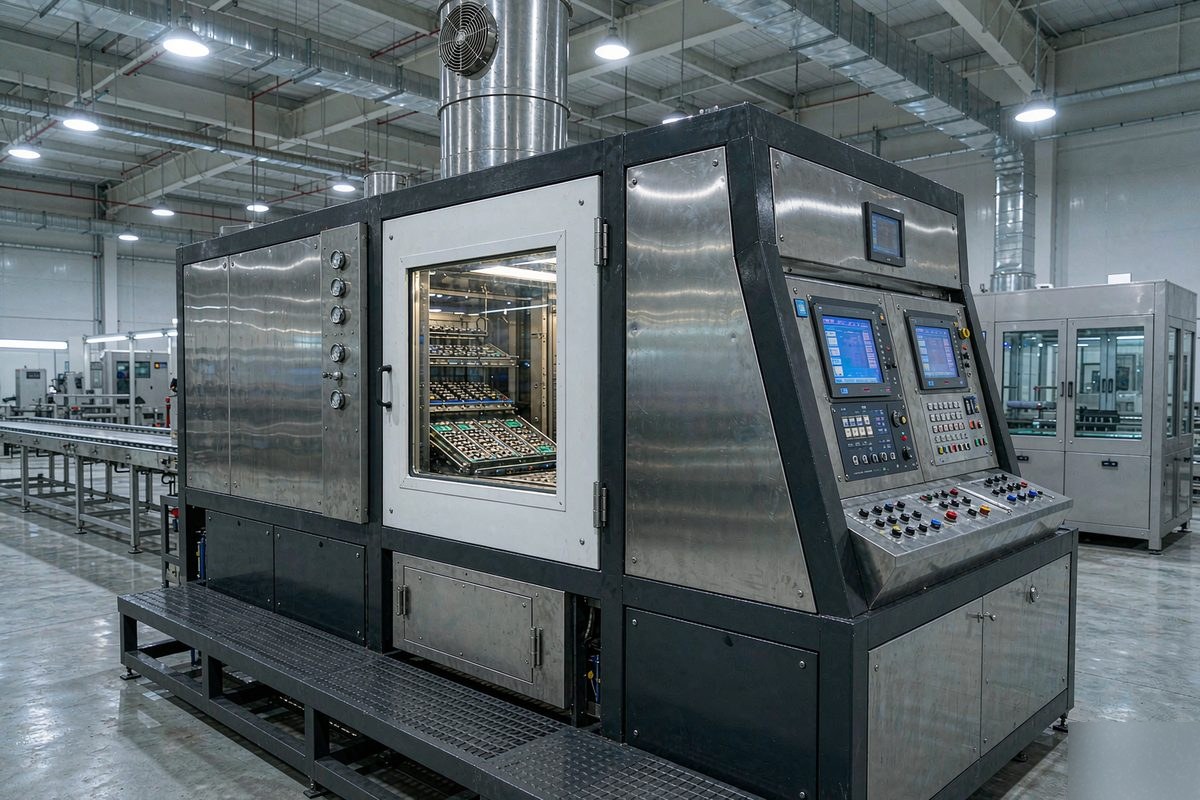
Placed, reflowed and tested on the same campus
Assembly sits downstream of fabrication, which removes the usual handover problems: no re-packaging, no third-party tolerance stack-up, and one engineering contact who can see both the bare board and the populated assembly.
- SPI before placement and AOI after reflow on every production run
- X-ray on BGA and via-in-pad joints, ICT and FCT functional test on request
- Turnkey, consigned or hybrid sourcing — your choice per order

What the lines place
Published process windows for the assembly floor. If a package is not listed, send the datasheet — the answer comes from the line engineer, not a sales sheet.
| Technologies | SMT (single & double-sided), through-hole (DIP), mixed technology |
| Fine-pitch packages | BGA, QFN, CSP, LGA, QFP, connector & odd-form placement |
| Smallest passives | 01005 (0.4 × 0.2 mm) |
| BGA ball pitch | Down to 0.25 mm |
| Placement accuracy | ±0.03 mm (chip components), ±0.05 mm (QFP) |
| SMT capacity | Four lines, 500,000 placement points per day |
| Solder paste | No-clean, lead-free SAC305 standard; laser-cut stencils cut in-house |
| Reflow | Nitrogen-capable convection ovens, profiled per board revision |
| Through-hole | Wave, selective and hand soldering on a dedicated DIP line |
| Component sourcing | 70,000+ SKU library, 35+ procurement specialists, authorised distributors only |
| Conformal coating | Acrylic, silicone and polyurethane; selective or full-board |
| Box build | Enclosure assembly, cable assembly, labelling, drop-ship packaging |
From BOM to boxed product
Every stage has a defined input, output and inspection gate. Nothing moves forward on an unreviewed revision.
DFM / DFA review
Fabrication review plus assembly review: footprint vs datasheet, courtyard, polarity, paste aperture, panel depaneling method.
Sourcing & BOM lock
Every line item sourced from authorised distributors. Lifecycle, counterfeit risk and second-source options documented before the PO.
Stencil & program
Laser-cut stainless stencil matched to the paste layer, feeder setup and placement program verified against the centroid file.
SMT & reflow
Solder paste inspection (SPI) before placement, AOI after reflow, thermal profile archived per board revision.
Through-hole & rework
Wave or selective soldering, hand-touch station for odd forms. Rework performed under an ESD-controlled, logged process.
Test & coating
ICT or flying probe, X-ray voiding on BGA, functional test to your procedure, then conformal coating and final QC.
What gets checked, and how often
Inspection frequency is published on the quality page. The methods behind those numbers:
| Method | Catches | Coverage |
|---|---|---|
| SPI | Insufficient, excess or shifted solder paste — before it becomes a joint | 100% of pads, every panel |
| AOI (pre & post reflow) | Polarity, offset, tombstoning, missing parts, solder bridging | 100% of boards |
| X-ray | BGA / QFN voiding, head-in-pillow, hidden joint defects | Sampling per IPC, or 100% on request |
| ICT / flying probe | Shorts, opens, passive values, diode orientation | Per test plan agreed at quoting |
| FCT | Function to your test procedure, firmware, calibration | Per your fixture and spec |
Turnkey, consigned or partial
Three ways to run the BOM. Most customers start turnkey and keep strategic parts consigned.
Turnkey
Send the BOM and centroid file. We quote parts from the 70,000+ SKU library, flag long-lead and end-of-life items, propose alternates, and take responsibility for what arrives at the line.
Consigned
You supply components against our incoming inspection standard. Best for programmed or supplier-locked parts. We handle storage, kitting and placement.
Hybrid
Standard passives and connectors from us; proprietary, programmed or excess-stock parts from you. The BOM is split at quoting, so there is no ambiguity on the floor.
Assembly schedule
Includes DFM/DFA review, stencil, programming, placement, AOI/X-ray and basic functional check. Runs in parallel with fabrication wherever the stackup allows.
Production run with committed ship date, ICT/FCT coverage per test plan, and packaging to your drop-ship spec.
Turnkey sourcing adds 5–15 days before the line, depending on component lead times. The BOM review tells you that number in the first 24 hours — not after the order is placed.